The Big Blue: Why Australians Have Been Practicing Ocean Therapy for Generations

There is something almost universally comforting about being near the ocean.
Perhaps it is the sound of the waves. Perhaps it is the horizon stretching endlessly into the distance. Or perhaps it is simply the rare opportunity to stand somewhere that reminds us how small we are in the grand scheme of things.
Whatever the reason, most of us instinctively know how it feels.
We arrive at the beach stressed, overwhelmed or carrying the mental clutter of everyday life. An hour later, after a walk along the shoreline or a swim in the ocean, something has shifted. We feel calmer, lighter and more present.
For centuries, people have believed seawater possesses healing properties. Long before wellness influencers were extolling the virtues of ice baths and cold plunges, entire medical movements were built around the therapeutic benefits of the sea.
The practice even has a name. It's called thalassotherapy.
Derived from the Greek word thalassa, meaning sea, thalassotherapy refers to the use of seawater, sea air, marine mud, algae and ocean-based treatments to improve health and wellbeing.
The concept dates back thousands of years. Ancient Greeks and Romans bathed in seawater and mineral-rich pools, believing they promoted physical and mental health. By the nineteenth century, doctors throughout Europe were prescribing seaside holidays as legitimate medical treatments for everything from anxiety and depression to respiratory illnesses and fatigue.
Victorian physicians regularly recommended extended stays by the sea, while coastal sanatoriums emerged across Britain and Europe to treat patients suffering from a range of physical and psychological ailments.
Of course, Australia has never really embraced thalassotherapy in quite the same way as Europe.
You are unlikely to find medical seawater clinics lining Australian coastlines in the way you might in France, Spain or Portugal. What we do have, however, is something arguably far more interesting: an entire culture built around the ocean itself.
Long before seawater therapy became a wellness trend, Australians were already doing it.
Every morning, thousands of people around the country head to beaches, ocean pools and coastal rock platforms to swim, float, surf, walk or simply sit by the water. Surf lifesaving clubs have been part of Australian life for more than a century. New South Wales alone is home to almost 100 ocean pools, many carved into headlands generations ago.
Today, that relationship appears to be evolving rather than disappearing.
Ocean swimming groups continue to grow, particularly among midlife women. Cold-water swimming communities have emerged around the country. Wellness retreats increasingly incorporate ocean immersion, breathwork and nature-based therapies into their programs.
Organisations such as Jervis Bay Ocean Therapy have built entire wellbeing programs around connection to the sea, while retreats including Gaia Retreat & Spa and Gwinganna integrate restorative practices that draw heavily on the calming effects of nature.
In many ways, Australia's version of seawater therapy is less about luxury treatments and more about community, ritual and lifestyle.
And perhaps that's what makes it so fascinating.
Many of the benefits we associate with the ocean today have increasingly been supported by modern research.
Marine biologist Wallace J. Nichols popularised the term Blue Mind to describe the mildly meditative state many people experience in and around water.
According to Nichols, being near water can trigger changes in brain activity associated with reduced stress, improved mood, increased creativity and greater feelings of connection.
Researchers have found that time spent near the ocean is associated with lower levels of anxiety, improved mental wellbeing and reduced psychological distress. One study published in the journal Health & Place found people living near coastlines often report better overall health than those living further inland.
Part of this may be environmental. Beaches encourage movement, walking and swimming. Ocean environments also tend to expose us to natural light, which supports healthy sleep patterns and mood regulation.
Then there is the water itself.
Deep seawater, drawn from depths of more than 200 metres, contains a range of minerals including magnesium, calcium, potassium and trace elements that researchers continue to investigate for potential health benefits. Some studies have explored its possible role in cardiovascular health, exercise recovery and metabolic function, although much of the research remains preliminary.
Swimming in the ocean may also offer benefits beyond simple exercise. Cold water immersion has been linked to improved circulation, reduced inflammation and the release of endorphins and other neurochemicals associated with mood regulation.
Psychologists are increasingly interested in the phenomenon too.
Benjamin Watkins, Director and Principal Counsellor at Watkins Therapy Group on Victoria's Mornington Peninsula, says the connection between the ocean and mental wellbeing is something he sees regularly in both his personal and professional life.
"As someone who lives and works on the Mornington Peninsula, the connection between the ocean and mental wellbeing is something I see often, both personally and professionally," he says.
"We are surrounded by beaches here, and many people I speak with describe the water as a place where they can breathe properly, slow down and feel more like themselves again."
Watkins says there are several reasons people often report feeling calmer around the ocean.
"From a counselling perspective, I think the ocean works on us in a few different ways," he says.
"It gives the nervous system fewer demands to respond to. The sound of waves, the open horizon, the rhythm of the tide and the sensory experience of sand, salt air and water can all help shift people out of a stressed, overstimulated state and into something calmer and more grounded."
When people describe the ocean as healing, he believes they are often describing something far less mystical.
"When people describe the ocean as restorative or healing, they are often describing nervous system regulation," Watkins explains.
"It is not that the ocean magically fixes things, but it can create the conditions for people to feel safer, more present and less caught up in their thoughts. In therapy, we often talk about grounding, breathing, mindfulness and reconnecting with the body. The ocean naturally encourages many of those things without people necessarily realising they are doing them."
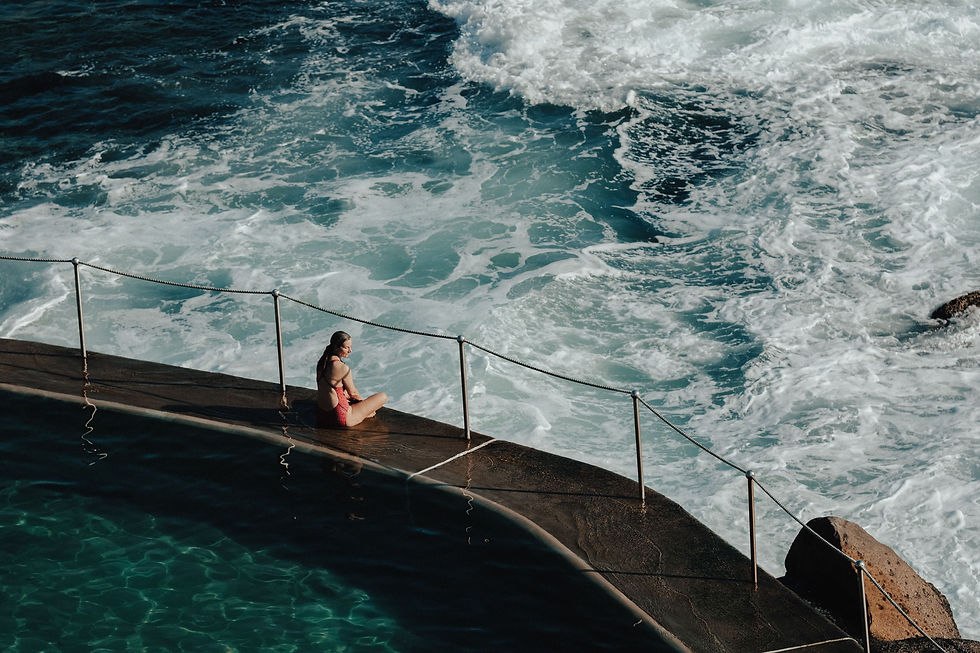
Research continues to explore exactly what is happening, but many experts believe the ocean may help reduce stress by encouraging mindfulness, lowering sensory overload and activating the body's relaxation response. Unlike our phones, emails and social feeds, the ocean demands very little from us. It simply asks us to be present.
Another reason the ocean may be beneficial is that many of the activities associated with it naturally support mental wellbeing.
"Activities like ocean swimming, floating, surfing or simply sitting by the sea can each offer different benefits," Watkins says.
"Swimming and surfing involve movement, breath, focus and often community. Floating can help people surrender some of the physical tension they have been carrying. Even sitting near the water gives people permission to pause, which is something many of us are not very good at in day-to-day life."
Anyone who has ever sat watching waves roll onto a beach understands the feeling.
For a short time, the endless mental to-do list seems to fade into the background. Problems often feel smaller, breathing slows and the nervous system softens.
Whether this is biology, psychology or simply the result of spending time in nature remains the subject of ongoing research. Most likely, it is a combination of all three.
Watkins also believes our attraction to water may run deeper than simple relaxation.
"I think our attraction to water is deeper than just psychology," he says.
"Humans tend to feel better when we are connected to nature, and the ocean gives us a strong reminder that we are part of something bigger than our inbox, our deadlines or whatever is happening on our phone. There is something very humbling and regulating about standing near the water and realising the world is still moving, even when your mind feels stuck."
None of this means seawater is some magical cure-all.
The ocean won't solve your financial problems, fix a difficult relationship or eliminate the stresses of modern life. But it may offer something increasingly rare in today's world: a chance to slow down.
The sea demands a different pace.
Phones lose reception. Notifications become irrelevant. The endless cycle of news, emails and social media begins to fade into the background. For a brief moment, our attention shifts away from what is happening on a screen and returns to what is happening around us.
Perhaps this is why so many cultures throughout history have viewed the ocean as restorative.
In Japan, the practice of shinrin-yoku, or forest bathing, encourages people to immerse themselves in nature for mental wellbeing. Seawater therapy operates on a similar principle. The healing may not come solely from the water itself but from the experience of stepping away from the noise and reconnecting with something larger than ourselves.
Watkins believes this may explain why so many people continue to be drawn back to the sea.
"In a busy, technology-driven world, I think people are being drawn back to the ocean because they are craving simplicity," he says.
"The ocean does not ask anything of you. It does not send notifications. It does not need you to perform. For many people, that alone can feel like relief."
Perhaps that's why so many Australians describe the beach as their happy place. It isn't necessarily the salt water itself. It may simply be one of the few places left where life asks nothing of us except to be there.
Whether you call it Blue Mind, thalassotherapy or simply a day at the beach, the underlying message remains surprisingly simple.
Humans evolved in nature, yet increasingly live apart from it.
The ocean may not be medicine in the traditional sense, but perhaps it reminds us of something modern life often makes us forget: sometimes the most powerful therapies are also the oldest.
As Watkins notes, the ocean is best understood as part of a much bigger wellbeing picture.
"There is growing evidence that blue spaces, including oceans, lakes and rivers, can support mental wellbeing," he says.
"Being near water has been linked with improved mood, reduced stress and a greater sense of connection. The important thing is to avoid overstating it. The ocean is not a replacement for therapy, medical care or proper mental health support, but it can be a powerful protective factor and a really helpful part of someone's wellbeing routine."
"My view is that seawater therapy and Blue Mind are best understood as part of a broader wellbeing picture. Time near the ocean can help people regulate, reconnect and reset, especially when paired with other supports such as healthy relationships, movement, sleep, therapy and meaningful routines."


Comments