Tania Lacy Has a Few Regrets. Selling Out Isn't One of Them.
Updated: Aug 8

I'm going to take you back in time. Way back. It's the late '80s, when acid-wash double denim was perfectly acceptable, Brian Rochford bikinis were a must-have, Patrick Swayze was dancing dirty (and Jennifer Grey's nose was still original), Sony Walkmans were considered high-tech and Kylie Minogue was still your neighbour.
Speaking of Ms Minogue, it was around this time she was recording her breakout hit, The Loco-Motion. While filming the now-infamous music video, a fresh-faced, largely unknown choreographer named Tania Lacy was hired to teach Kylie the moves. Little did anyone know that not one, but two stars would emerge from that set. Kylie became a household name, while Lacy found the career-defining opportunity she never saw coming.

For many teenagers growing up in the late '80s, Tania Lacy became a familiar face. Not as a dancer, but as one of Australia's funniest comedians. Her rise, however, happened almost by accident. Literally.
At the time, Lacy had been accepted into the Victorian College of the Arts School of Dance, but after suffering a knee injury, was forced to hang up her ballet slippers. Instead, she channeled her love of dance into landing gigs on Australia's most influential music show, Countdown. Hosted by the eccentric, often gloriously awkward music critic Molly Meldrum, the program was famous for his wonderfully clunky interviews with some of the world's biggest stars and for launching countless music careers. It wasn't long before he spotted Lacy's talent and invited her to open several shows. But it wasn't her dancing that captured people's attention. It was her uncanny ability to make audiences laugh.
Lacy soon found herself on the newly launched ABC television show The Factory, where audiences discovered what those around her already knew: she had an innate gift not only for writing comedy sketches, but for creating some of Australia's most memorable characters, including Carlos the Latin Lover, Annette the Librarian and her irreverent take on Nana Mouskouri.

"I didn't have one of those life-altering moments where I thought, 'Oh my gosh, I have to be a comedian.' I do have two very specific memories from when I was about five. I remember seeing a blonde woman on television being incredibly funny. I was completely mesmerised. Years later I discovered it was Goldie Hawn on Laugh In. Gilda Radner was another funny woman I caught a glimpse of somewhere. I don't know how or where I saw her, but I remember loving it. Those two memories have stayed with me my entire life."
Looking back, Lacy remembers those early years with enormous affection.
She wasn't overthinking who she was or where she was going. She was simply creating, trusting her instincts and having a bloody good time.
"Those early years... well, they were a great deal of fun. I think it’s important to note that it wasn’t just me doing all this work, it was a team - my director, camera operator, sound engineer and myself. We created a space where we pushed each other creatively and had each other’s backs. Oh, and we laughed... a lot.
"Honestly, the powers-that-be really didn’t give a shit about what I was doing, so much of the focus was on the male hosts. Management’s significant lack of interest unintentionally afforded me an incredible amount of creative freedom.
"I had no idea that what I was doing was original or different. I was simply thrilled to be writing, channeling my slightly rebellious streak into something creative and hoping it made people laugh," she said.

"Everything evolved very organically, even if part of the reason was management's neglect. Without anyone looking over our shoulders or steering the work, we trusted our instincts. What we created connected with audiences in a meaningful way. I can't tell you how happy that made me."
It was that rare, unmistakable authenticity Aussie audiences couldn't get enough of. Her fan base quickly grew into a cult following thanks to her bold, offbeat and unapologetically original appearances on everything from Hey Hey It's Saturday and Midday to Steve Vizard's Tonight Live.
Yet behind the laughs, the growing fame and all the perks that came with it, Lacy was learning that being a female comedian in Australia wasn't all it was cracked up to be. In many ways, the industry didn't quite know what to do with her and, perhaps, it still doesn't.
When I ask whether Australian comedy has lost some of its nerve, and whether we're still making space for people who are genuinely funny, odd and original, Lacy doesn't hesitate.
"If you would indulge me, I'd like to focus on the 'odd' element. If we're talking about what we used to call 'mainstream success', I think 'oddness' is hugely undervalued. Odd seems to be okay if you're a guy. Aaron Chen and Sam Campbell are two names that spring to mind. But when I look at the female comedians with mainstream success, I don't see that oddness. Maybe we don't like 'odd' in our women or, more likely, TV executives don't like it.

"I do believe the women on TV in the '70s were far more groundbreaking, individual and odd - Mary Hardy, Noelene Brown, Jeannie Little and Denise Drysdale. Having said that, there's plenty of space for oddness in the social media world. It appears, though, if you want to be on Aussie TV, don't be an odd girl."
"In the 35 years I've been in this industry, I've heard countless male comics described as 'tortured geniuses', 'loveable weirdos' or 'crazy horses'. I have never, not once, heard a female comic described to me as a genius.
"I've seen people speak about a male comic's addiction with enormous compassion, almost as though it was part of his mythology. Yet, when a well-known female comic spoke publicly about her alcoholism, she has barely worked since.
"This expectation that women should be likeable, agreeable and easy to package, while men are allowed to be difficult, chaotic and uncompromising because those qualities are apparently evidence of brilliance, is tired and long past its use-by date.
"I think this expectation has given us a very homogenised idea of what women should be. We've been encouraged to be polished, pleasant and reassuring. Personally, I'm much more interested in women who are messy, contradictory, funny, angry, fearless and unapologetically themselves.
"Those in power need to let go of this outdated idea of the perfect woman, the nice woman, the good girl. Give me a bad girl any day. We all have one inside us. She deserves as much space and as much permission to exist as anyone else."
Whether you believe in the idea of "selling your soul to the devil" or see it as nothing more than a metaphor, Lacy doesn't hesitate. In her view, it happens every day, not through some supernatural pact, but in the choices people make in pursuit of fame and fortune. The real bargain, she argues, begins the moment someone trades their originality, integrity or values for success. From celebrity endorsements to influencer culture, too many public figures are willing to promote brands they know exploit workers or engage in greenwashing, all for a pay cheque.
"I've seen the amoral depths people will sink to for success. I've personally survived the fallout of one person's cutthroat opportunism. It begins when someone trades their uniqueness for a payday and, hey presto, here we are in this weird corporate celebrity culture. I mean, what are The Kardashians if not one long infomercial to hock their wares? Today we're more aware than ever of things like forced labour and greenwashing, yet public figures happily act as the faces of brands that exploit and destroy. When a person willingly trades their ethics to make a buck, they haven't just made a bad career move. They've quite literally sold their soul."
For all her criticism of celebrity culture, Lacy has no problem admitting she loved being famous.
"I found being famous to be so much fun. Life is better when you're famous. There, I've said it. Please don't hate me," she laughed.
"It's incredibly affirming and you get lots of free stuff. I'm not famous anymore, and I'll tell you what's hard about fame... losing it. That's a painful process.
"But like all the ups and downs in my life, I came out the other side. I look back on that time with fondness, confusion, gratitude and a little regret."
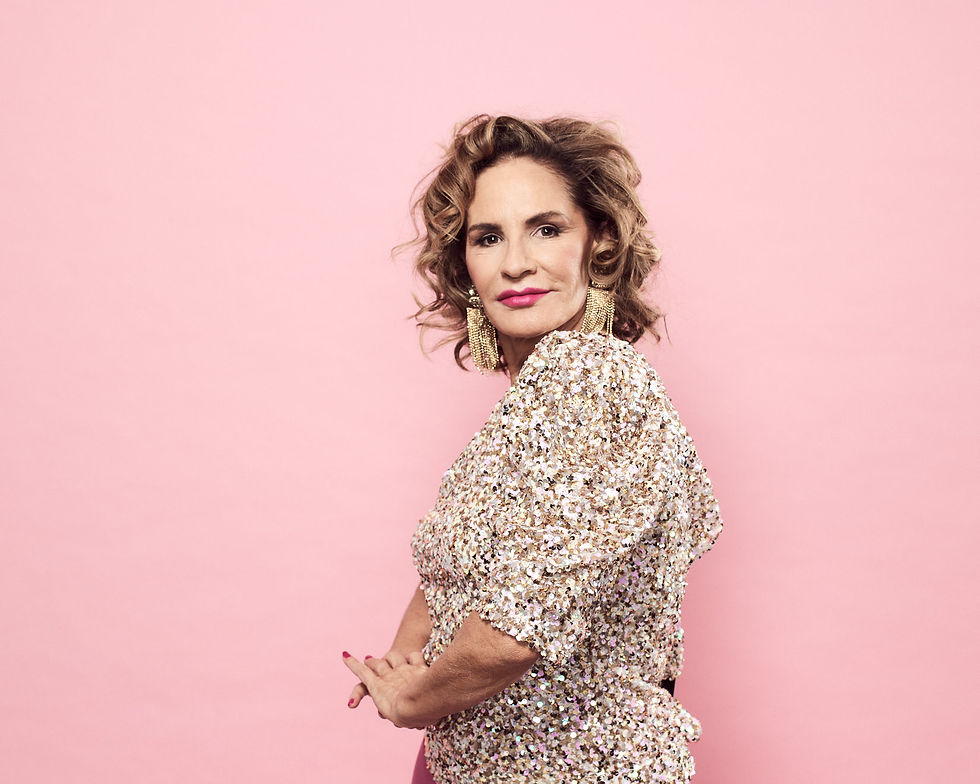
Regret is an interesting takeaway from someone so often followed by the question, "Whatever happened to Tania Lacy?" It's a question we seem to ask of anyone who once enjoyed success before quietly stepping away, as though leaving the spotlight somehow means disappearing altogether.
But the reality couldn't be further from the truth.
Lacy never vanished.
She simply stopped playing the game. While many chased fame, she chose something far less glamorous, but arguably far more valuable: a life on her own terms.
Unlike some who reached the dizzying heights of celebrity by saying yes to everything and everyone, Lacy was never prepared to trade who she was for a pay cheque or public approval. She readily admits there are career decisions she'd make differently, but compromising her values has never been one of them.
"I know we're told we're supposed to live our lives free from regret, but I think that's a bit of a romantic myth," she said. "There are heaps of things I'd do differently. The messy parts made me who I am, sure, but if I could turn back time, I'd happily skip some of those life lessons. Character building can be highly overrated."

If saying no to the devil's bargain came at a price, Lacy was happy to pay it. While others chased fame, she simply got on with the business of creating. She wrote and performed sell-out one-woman shows at the Melbourne International Comedy Festival before touring Australia and taking them to the Edinburgh Fringe, where she was nominated for Best Newcomer and shortlisted for the prestigious Perrier Award. She also wrote and starred in award-winning short films, including Titsiana Booberini and Pussy Got Your Tongue?, winning the Nicole Kidman Best Actress Award at Tropfest before taking home another Best Actress award for Tangerine Dream. A move to Los Angeles followed, where she performed another one-woman show in Hollywood and met her future husband. Returning to Australia, she continued writing for film and television before publishing a series of children's books with Scholastic.
Looking back, it's hard to argue Tania Lacy ever disappeared.
She simply walked a different path, one guided by creativity rather than the spotlight.
These days, Lacy's definition of success looks very different. Family comes first. In a matter of weeks, she'll graduate with a law degree at 61 while also stepping back onto the stand-up stage after walking away from showbusiness several years ago. What's next? Even she isn't entirely sure.
"I don't quite know the legal world is ready to welcome a 61-year-old beginner, but you can only try. I made a decision a couple of years ago to walk away from showbusiness because it was hurting me too much. Then a friend convinced me to dip my toe back in the water, so I'm doing a stand-up gig at the end of the month.
"I don't know what I'm doing with my life right now. Law? Comedy? What the hell am I thinking?"


Comments